YOUR SIMPLE GROWING PLAN
A garden bed. Here’s the plan.
A garden bed with morning sun or bright partial shade. Start with nursery plants.
One row of 3 plants, 24 inches apart, centered across the bed’s width.
Young plants usually make leaves first. Buy flowering plants if you want an immediate display.
- 01
Mark three positions
In a 6 × 3 ft bed, mark positions 1, 3, and 5 ft along its length, centered across the width.
- 02
Plant at the existing soil level
Dig each hole wider than its root ball and equally deep. Keep the crown level with the ground, then return the soil around it.
- 03
Water and leave breathing room
Soak the root zone. Keep mulch off the crowns and give the leaves room for air to move.
- 04
Let the flower spikes rise
A young leaf rosette may wait until its second year to flower. Loosely support tall stems when needed; remove spent spikes to limit seed spread.
Another way to start
Choose a first-year-flowering cultivar+
A labeled cultivar such as ‘Foxy’ can flower in its first year and stays shorter than many ordinary foxgloves. Follow that plant’s tag. A generic young Digitalis purpurea should not be sold with the same first-year promise.
When to water.
Check new plants regularly, including the original nursery root balls. Feel under any mulch: when the upper 1–2 inches begin drying, water the root zone slowly before the root ball dries out. This is a practical checking routine, not a fixed calendar. Wait if wet and improve drainage if water lingers.
Exactly what to feed it.
In a reasonably fertile bed, skip regular liquid fertilizer. If the soil needs organic matter, a 1-inch spring compost top-dressing is a simple option; keep it off the crowns.
THE SIMPLE FEEDING PLAN
Start without extra fertilizer.
Buy no branded feed for this default plan. If plants remain weak after light, moisture, and drainage are corrected, use a soil test and follow its recommendations. Extra fertilizer will not reliably make a first-year rosette bloom.
A little patience pays off.
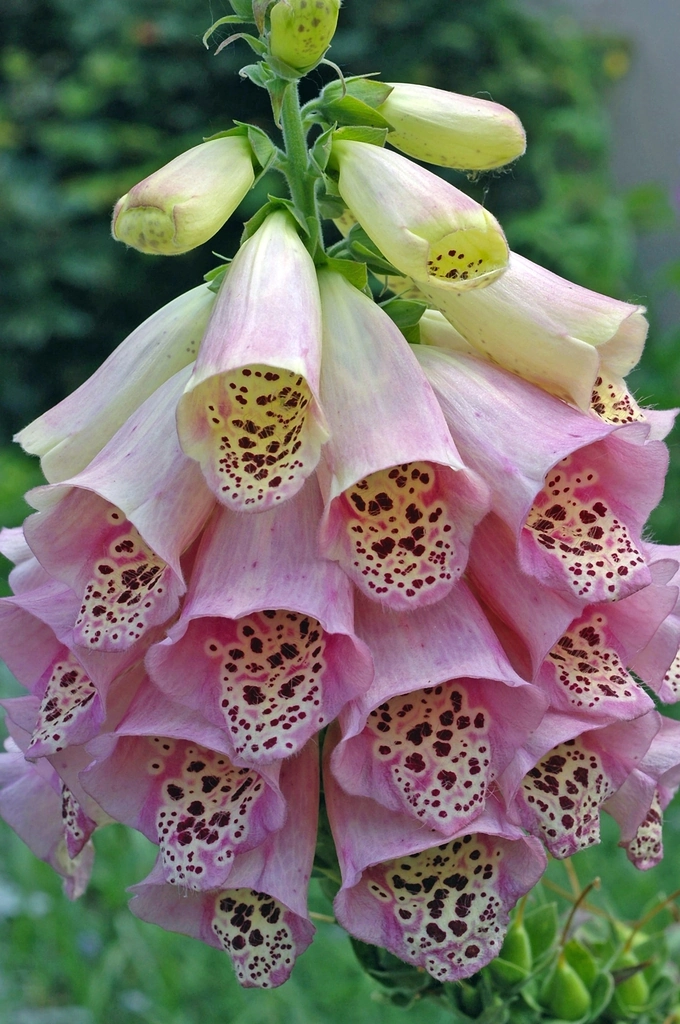
Ordinary foxgloves usually make a leaf rosette in year one and tall bells in late spring or early summer of year two. Many spikes reach 3–4 ft. These are biennials or short-lived perennials, so a plant may die after flowering.
When should I start where I live?+
Plant nursery starts in moderate spring conditions. In hot regions, afternoon shade helps. Check local Extension before allowing foxgloves to self-seed, as regional suitability and naturalization differ.
For regional planting windows, find your local Cooperative Extension office ↗.
Something looking off?
I only have a low circle of leaves.+
That can be normal in year one. Check the nursery label for a first-year-flowering cultivar before assuming a problem.
Why is it wilting?+
Check the root-ball moisture first. Both dry roots and poor drainage can cause trouble; do not add water to already soggy soil.
The leaves have a powdery coating.+
Powdery mildew can occur. Improve crowding and air movement, and remove badly affected foliage. Ask local Extension if you are unsure of the diagnosis.
A little more growing know-how.
Keep this ornamental away from tasting hands+
All plant parts are highly poisonous if swallowed. Avoid foxgloves where children or pets are likely to chew them. Wear gloves if your skin is sensitive.
Decide whether you want seedlings+
Removing spent spikes limits self-seeding. Because individual plants may die after bloom, deadheading can mean buying replacements. Do not promise a permanent clump or unlimited repeat flowering.
BEHIND THIS GUIDE
Where the advice comes from.
Plant care is based on the sources below. Planting layouts and beginner routines combine that guidance into one practical plan; they are editorial choices, not results from a Plant Care Steps growing trial.
- Wisconsin Extension: common foxglove life cycle and care ↗
- NC State: foxglove growth and toxicity ↗
- RHS: foxglove growing guide ↗
- Maryland Extension: caring for garden flowers ↗
- Iowa State: planting perennials ↗
- ASPCA: foxglove and pets ↗
Compiled with AI assistance. These first-edition guides have not yet had an independent horticultural review. Read our editorial approach.