GROWING BASICS · INDOORS
Find the right light
for your indoor plant.
Check the light at the leaves. Then make one small change at a time.
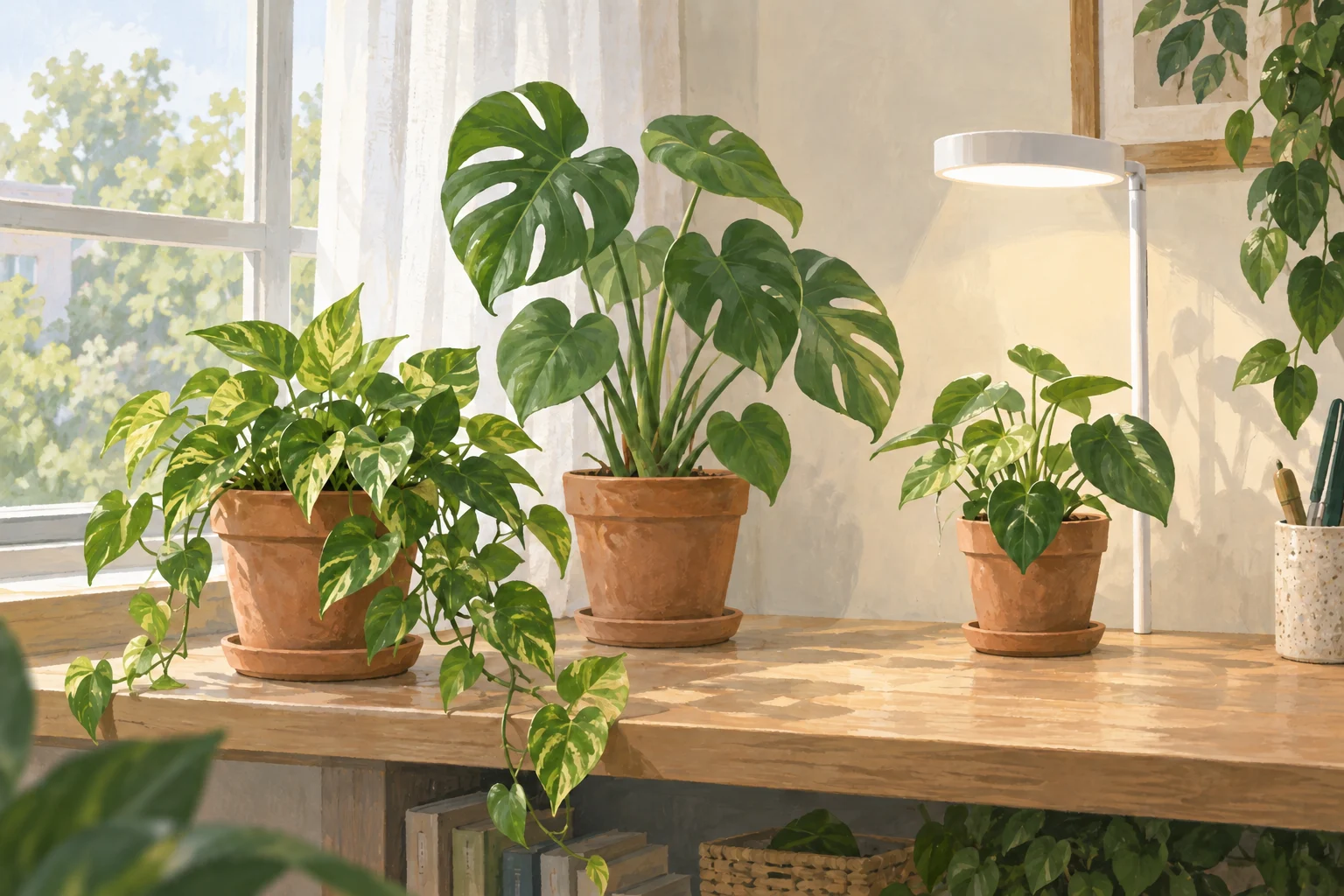
1. Choose the spotWatch for direct sun and shade.
2. Measure at the leavesFollow your sensor’s instructions.
3. Count steady-light hoursA lamp’s output × its daily time.
Start with the place you have.
- Check the plant’s own guide. Match its light needs to the window. Nearby buildings, trees, curtains and the season all change what reaches the leaves. A room that looks bright to you may still offer little useful plant light.
- Look at the leaves’ position. For bright, indirect light, keep the plant in useful window light without a strong direct beam on its leaves. Compare the actual spot at different times of day; there is no single distance from a window that suits every room.
- Measure when you need a closer comparison. A PAR/quantum sensor reports PPFD, the light arriving each second. Position it at leaf level as its maker directs, keep yourself from shading it, and note the time and conditions. A single window reading is only a snapshot.
OPTIONAL · FOR A STEADY GROW LIGHT
How much light adds up in a day?
Daily light integral (DLI) adds up light over time. Measure with daylight excluded so the reading represents the lamp alone. Enter the hours it runs at that steady output; the result is the lamp’s daily contribution. Daylight adds more.
DLI = PPFD × hours × 0.0036
For example, 100 PPFD for 12 hours gives 4.32 mol·m⁻²·day⁻¹.
This is a light total, not a recommended target or a diagnosis. For changing sunlight, DLI requires readings integrated through the day; do not multiply one midday reading by all daylight hours. Lux and phone brightness readings cannot be entered as PPFD.
Make one small change.
Move the plant gradually into stronger light, or adjust a grow lamp using its manufacturer’s placement instructions. Use a timer and a daily dark period suited to the plant; the calculator’s 24-hour input limit is not a recommendation to leave lights on all day.
Watch new growth and check the potting mix before watering. Light is only part of plant care; extra fertilizer cannot replace it.
If the mix stays wet while the plant wilts, check drainage and roots before adding more water.
Return to your plant’s plan: pothos, green monstera, spider plant or baby rubber plant. Browse indoor plants →
Sources & editorial notes
- Purdue Extension: Measuring Daily Light Integral (DLI) — PPFD, daily accumulation and measurement.
- University of Maryland Extension: Lighting for Indoor Plants — window conditions and supplemental lighting.
- NDSU Extension: Lighting — DLI formula (page 9).
- University of Minnesota Extension: Spring houseplant care — gradual changes in light.
Sources checked October 6, 2026. This is an editorial guide compiled with AI assistance, not a Plant Care Steps growing trial. The illustrations show a method, not measurements from a particular room. Editorial responsibility.
Published · Updated
Something needs updating? Suggest a correction