
GROWING GUIDE
Phalaenopsis Orchid Care for Winter
A moth orchid, Phalaenopsis, spends the winter indoors in bark that drains. Water the bark thoroughly, let it dry slightly, and do not leave the pot standing in water. Winter light can be brighter than summer light. Only University of Maryland Extension tells you to pause fertilizer in winter; the other cited pages do not.
Published · Updated
The moth orchid in the house
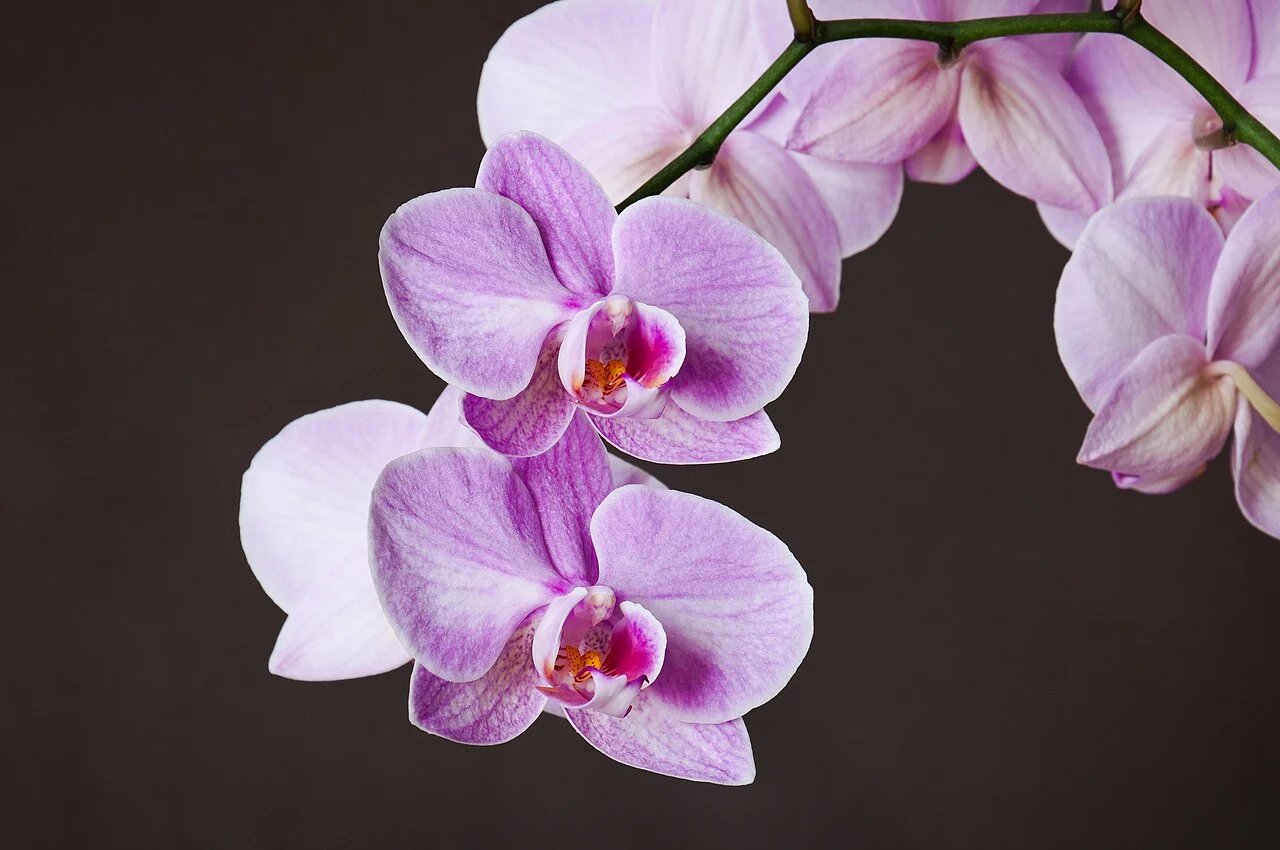
This page is Phalaenopsis, the moth orchid. University of Maryland Extension says the plants grow on trees in warm tropics, so roots often stay above the pot and even run along the shelf. That is normal. Do not cut those roots off. Maryland and Missouri both say these orchids have no pseudobulb for storing water. Missouri describes a single upright stem, with flowers arising at the base of the leaves, and the common name moth orchid for the flat flower. Missouri’s color note for the hybrids is mainly white and pink. Cornell says the blooms are often 1 to 2 inches and can run from white and yellow to deep purple, lasting 4 to 6 months once open. Maryland says the flowers can last at least a month, or longer with care. Those durations are both cited. They are not averaged here.
Light and temperature
Maryland says normal room temperatures and indirect light from an east or west window. In the short days of winter the plant can be moved into direct light or a south window. Leaves that are light green are getting a useful amount of light. Dark green, very stiff leaves mean the light is low. Pink or reddish edges, with leaves that look yellow-green or almost yellow, mean the light is very high. An interior room can use a grow light. How long to run a lamp is a different page: grow lights for indoor plants.
Cornell says an east or west window in winter, and to keep the plant out of direct sun, especially in summer. That is stricter than Maryland’s winter south-window note. Cornell’s temperature range is a minimum of 60°F at night and a maximum of 85°F by day, and a house near 65°F in winter and 75°F in summer suits them. Missouri says Phalaenopsis wants about 1,000 to 1,500 foot-candles, about the light an African violet wants, with days near 75°F and nights near 65°F. Fluorescent or LED lamps can supplement a dim spot. Maryland’s fetched page says “normal room temperatures” and does not add a degree range.
Water the bark, then let it drain
Maryland’s method for bark is a sink or tub: warm water over the plant, the bark, and the aerial roots, in three or four passes across about 10 minutes, so the bark can take the water up. Let it drain completely before it goes back on a saucer and into the window. Under ordinary home temperatures, that watering should not be needed more than once a week. Aerial roots shift from dull silver or white toward pale green when they have had enough. Misting usually does not supply enough water indoors. A pebble tray can raise humidity if you do not flood it. Flooded roots can rot. Wrinkled leaves can mean the air is dry and the plant has had too little water.
Cornell says water thoroughly, then let the mix dry slightly. Watering too often can rot the roots and kill the plant. Do not get water into the growing tip or into leaves that are just unfolding. Water more often while the plant is growing and while it is in bloom. Aim for 40 to 60 percent relative humidity. A pebble tray is fine if the bottom of the pot stays above the water. A bark mix should drain quickly and still hold some moisture.
Missouri’s interval for Phalaenopsis, which has no pseudobulb, is a thorough soaking about every 5 to 7 days, depending on the room. That is Missouri’s number, not a rewrite of Maryland’s “not more than once a week.” Missouri prefers humidity of 60 to 70 percent, higher than Cornell’s 40 to 60 percent, and describes a tray of gravel with water kept in the bottom of the tray. Cornell is the page that says the pot itself stays above the waterline. Maryland is the page that says not to flood the tray.
The site’s winter watering guide is the general houseplant check. It does not replace these orchid pages.
Fertilizer, and the winter pause
Only Maryland states a winter pause. Skip fertilizer during the cooler temperatures and lower light of the winter months. While the plant is actively growing and flowering, Maryland says fertilize every third or fourth watering with a commercial orchid fertilizer, following that label. Extra fertilizer often makes leaves at the expense of flowers.
Cornell does not state that pause. It says bark mixes usually do not contain enough fertilizer, and that a water-soluble houseplant fertilizer at one-half the label rate, once or twice a month, is enough.
Missouri does not state that pause either. An orchid fertilizer can be added when you soak the plant. For bark, Missouri recommends a high-nitrogen fertilizer such as 30-10-10.
After the flowers fall
Use the page you are following. Do not mix the cuts.
- Maryland: low light is the usual reason a plant does not flower again. Move it to a brighter window, or outdoors in shade for the summer. Cooler fall nights can help set buds. Bring the plant in when evening temperatures dip into the fifties. After the flowers drop, watch the old spike for new buds. To encourage another flowering, cut a yellow or brown spike back to about one-half inch above the second node above the leaves. Cut old yellow leaves, or an old dried brown spike, off at the base of the plant.
- Cornell: after flowering, cut the spike off at the point where it emerges. To encourage a second bloom, cut the spike just above the first bud that was produced on it. With enough light, water, and fertilizer, Cornell says the plant flowers about once a year, and maybe more.
Missouri’s fetched article does not give an after-bloom cut for Phalaenopsis.
When the bark stops draining
Maryland says replace the mix every 1 to 2 years, before it breaks down, or when the plant has outgrown the pot, or when the bark looks like mulch, drains poorly, and stays wet. The better time is when new growth has started, not automatically when the flowers finish. Use an orchid bark mix and a container that drains well. If roots have stuck to the pot, soak them until they can be eased off. Cut dead, discolored, or damaged roots.
Cornell says repot when the roots are almost bursting out, typically every two or more years, with the same soak before you pull stuck roots free.
Missouri says repot when growth weakens, usually about every third year, into a porous pot. Clay is the pot Missouri calls ideal. Bark and osmunda fiber are the two media it names for Phalaenopsis.
Common questions
Do I pause fertilizer in winter?+
University of Maryland Extension says skip fertilizer during the cooler temperatures and lower light of winter. The Cornell and Missouri pages fetched for this guide do not state that pause. Cornell says a half-strength houseplant fertilizer once or twice a month. Missouri says an orchid fertilizer can go into the soaking water, and recommends a high-nitrogen formula such as 30-10-10 when the medium is bark.
What do I do with the spike after the flowers fall?+
The pages differ. Maryland says watch a faded spike for new buds, or cut a yellow or brown spike to about one-half inch above the second node, and cut a dried brown spike off at the base. Cornell says cut the spike off where it emerges, or, for a second bloom, cut just above the first bud on that spike.
Are roots growing outside the pot a problem?+
Maryland says aerial roots above the pot are normal for this epiphyte and should not be cut off. They turn from dull silver or white toward pale green when they have had enough water.
How bright is winter light?+
Maryland says an east or west window with indirect light, and that short winter days are a time when the plant can take direct light or a south window. Cornell says an east or west window in winter and to keep it out of direct sun, especially in summer. Missouri gives Phalaenopsis about 1,000 to 1,500 foot-candles.
Sources & editorial notes
- University of Maryland Extension: care of Phalaenopsis orchids
- Cornell Cooperative Extension of Warren County: orchids as houseplants
- University of Missouri Extension: orchids for winter
A source-based winter summary for Phalaenopsis, not a growing trial. Fertilizer and after-bloom cuts are attributed where the pages disagree. Sources checked November 19, 2026. Editorial responsibility.
Source checks concern the linked references, not results from a growing trial. This guide has not had an independent horticultural review. How we use sources.